How to Light a Living Room Without Overhead Lighting

A living room without a ceiling light can feel perfectly comfortable during the day and surprisingly gloomy by six o’clock. One floor lamp brightens the sofa but leaves the opposite wall dark. Add a brighter bulb, and suddenly the corner is glaring while the rest of the room barely changes.
The solution isn’t to recreate a ceiling fixture with one powerful lamp. It’s to spread light across the room at different heights, giving each source a specific job. With the right arrangement of floor lamps, table lamps and a few carefully placed accents, even a rental apartment can feel well-lit without new wiring.
Start With the Light You Already Have
Before buying anything, look at the room as it actually functions. The position of the sofa, television, windows and electrical outlets will influence your lighting choices more than the room’s square footage alone.
A living room needs enough general light to move around comfortably, but it also needs brighter light where people read, work or pursue hobbies. Those requirements aren’t necessarily met by the same fixture.
Check the Room After Sunset
Turn on every existing lamp after dark and walk through the room. Then sit in the places you normally use.
Pay attention to three things:
- Dark areas: Can you see comfortably around doorways, furniture and the main walking routes?
- Useful light: Can you read on the sofa without moving closer to a lamp?
- Uncomfortable brightness: Do exposed bulbs shine directly into your eyes or reflect in the television?
This simple inspection often reveals that the problem isn’t insufficient lighting everywhere. It may be one badly positioned lamp or a seating area that lacks its own light.
Daylight can also disguise problems. A north-facing apartment that feels adequately bright in July may need a different evening arrangement during shorter winter days.
Map the Outlets Before Buying Lamps
Draw a rough floor plan and mark every usable outlet. Include the wall switch that may control one of those receptacles.
In some older apartments, a switch near the entrance operates part of a wall outlet rather than a ceiling fixture. Plug a lamp into each candidate receptacle and test the switch before deciding how to control the room.
Outlet locations also determine where lamps can safely stand. Avoid designs that require cords to cross doorways or busy walking routes. If every outlet sits behind the sofa, plan around that constraint rather than assuming a long extension cord will solve it.
Replace One Overhead Light With Three Useful Layers
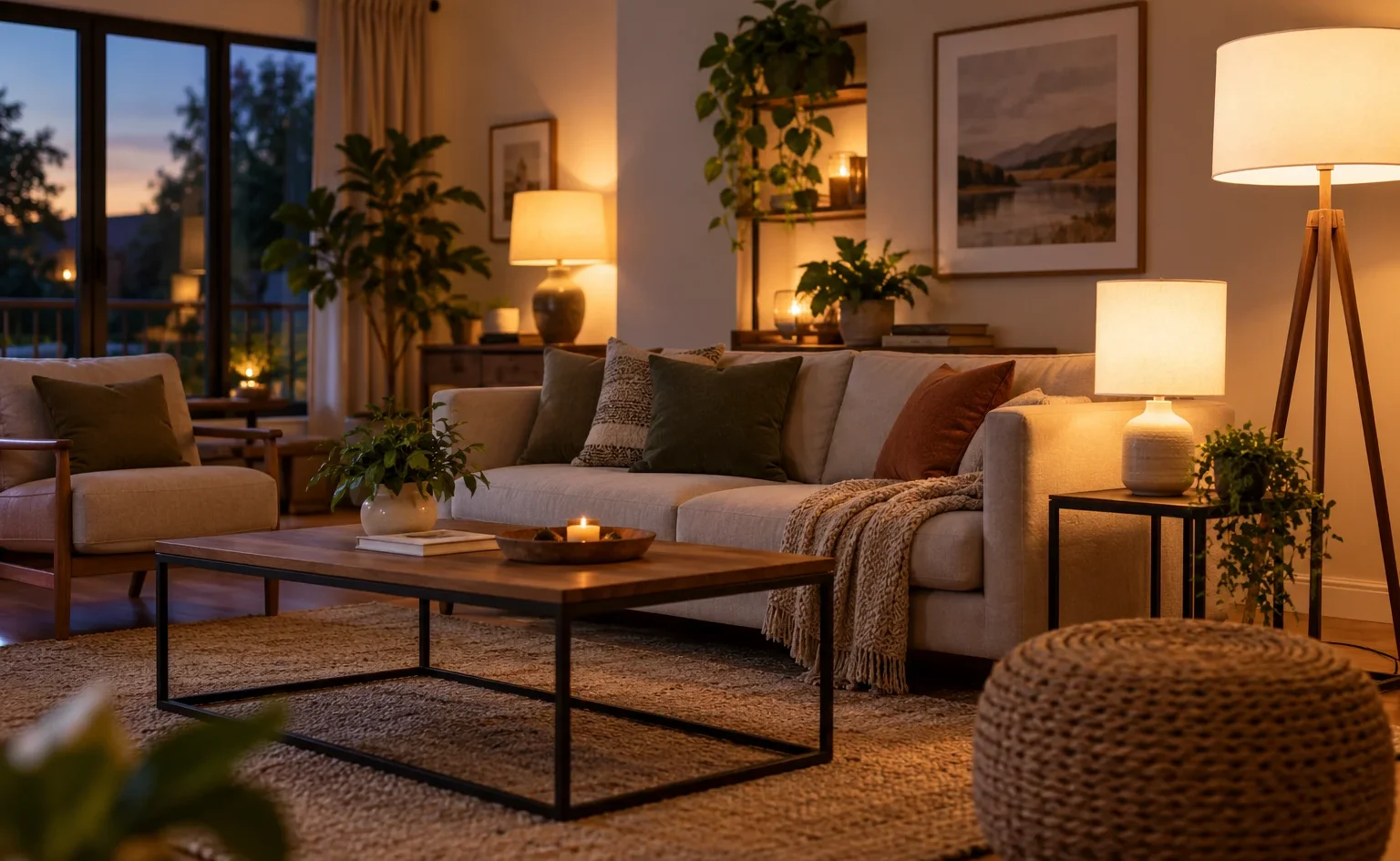
A good starting arrangement is one floor lamp for general brightness, one table or reading lamp near the main seat, and a smaller light toward the opposite side of the room.
The three sources don’t need matching shades or identical brightness. Their different positions are what make the arrangement useful.
Use a Floor Lamp for General Light
The first purchase should usually be a lamp that can illuminate more than one small spot.
A torchiere or uplighter directs light toward the ceiling, which reflects some of it back into the room. It works particularly well with a light-coloured ceiling, although the result will be less effective with dark paint or high ceilings.
A shaded floor lamp produces softer, more localized light. Choose a translucent shade if you want illumination to spread around the seating area.
An arc lamp can bring light over a sofa or coffee table without requiring a ceiling connection. However, its large footprint and projecting arm may be awkward in a narrow room.
Avoid exposed, high-output bulbs at seated eye level. A powerful lamp is only comfortable when its light is properly diffused or directed away from your eyes.
Add a Table Lamp Where People Sit
Table lamps bring light closer to faces, books and everyday activities. Their lower height also changes how the room feels: instead of relying entirely on light reflected from above, you introduce a softer pool of illumination around the seating area.
Place a lamp on a side table or console near the sofa. For reading, make sure the light reaches the page without the shade blocking it or the bulb shining into your eyes.
A decorative lamp with a heavily tinted shade may look attractive but provide very little usable light. Check its actual output before depending on it for reading.
Fill the Darkest Corner Without Overlighting It
The third source should address whatever remains noticeably dark.
A compact accent lamp on a bookshelf, a small shaded lamp on a console or a plug-in wall sconce may be enough. Its purpose is to balance the room rather than deliver another large burst of brightness.
Not every corner needs illumination. Some shadow creates depth. Concentrate on places where darkness makes the room uncomfortable or difficult to use.
Three Lighting Layouts for Different Living Rooms
Lamp placement becomes easier when you think about the shape of the room and where people spend time.
These layouts are starting points, not fixed formulas. Adjust them around your own furniture, outlets and walking routes.
A Small Apartment Living Room
Imagine a 10 × 12 ft living room (approximately 3 × 3.7 m), with a sofa against one wall, a television opposite and a window beside the seating area.
A practical arrangement would be:
- Floor uplighter: Near the sofa, positioned so it spreads light across the ceiling without interfering with the walkway.
- Table lamp: On a narrow side table beside the main seat, providing useful light for reading.
- Small accent lamp: On a shelf or console opposite the sofa, balancing the room after sunset.
If space is particularly tight, start with the first two lamps. A slim floor lamp may be more practical than an oversized arc fixture.
Keep bright lamps out of the television’s reflective sightlines. A lamp that looks unobtrusive while standing can create an annoying reflection when viewed from the sofa.
A Standard Living Room With Two Seating Areas
A larger living room with a sofa and a separate reading chair needs light in both locations.
Place a general-purpose floor lamp near the main seating area and a dedicated reading lamp beside the armchair. A third light on a console across the room helps prevent the background from disappearing into darkness.
This setup offers useful flexibility. Someone can read in the armchair while another person watches television without having to keep every lamp switched on.
If the room still feels dim, increase the useful general illumination before adding more decorative accents.
A Long, Narrow Room
Long rooms frequently suffer from uneven lighting because all the available outlets are grouped along one wall.
Putting three lamps next to those outlets produces a bright strip with a darker opposite side.
Instead, distribute your lighting along the length of the room. Use a tall floor lamp near one end, a table lamp around the middle and another source toward the far end, where a suitable outlet is available.
Think in overlapping pools of light rather than a row of isolated bright spots. Where the electrical layout doesn’t support that arrangement safely, rearranging furniture or using appropriately positioned existing receptacles is preferable to routing permanent extension cords across the space.
How Bright Should the Lamps Be?
Lumens tell you how much visible light a bulb produces. They don’t tell you exactly how bright your sofa, coffee table or floor will be.
That distinction matters in a room without overhead lighting. A lamp with an opaque shade may deliver far less useful general illumination than an uplighter containing a bulb with the same lumen rating.
For a practical starting example, consider this combination:
- A floor uplighter rated at 1,600 lumens.
- A shaded table lamp rated at 800 lumens.
- A smaller accent lamp rated at 450 lumens.
Together, those sources produce approximately 2,850 rated lumens. That is a hypothetical purchasing example, not a guarantee of a particular room-wide lighting level. The amount reaching each surface depends on the shades, direction, ceiling and wall finishes, and fixture placement.
Choose Lumens Based on the Job
General lighting should make the room comfortable to navigate, while reading lamps need enough concentrated light to illuminate a book or other task.
A well-positioned 450–800-lumen bulb may work for a nearby reading area, depending on its shade and beam distribution. The same bulb placed across the room could be inadequate.
Small accent lights can use much less output because their purpose is primarily visual.
Rather than buying the brightest available bulbs for every fixture, use more output where it will actually improve visibility. Dimming lets you reduce brightness when the room is used for relaxing.
Keep Bulb Colour Consistent
For most living rooms, 2700K creates a warm, relaxed appearance. 3000K remains warm but looks slightly cleaner and less golden, which can suit contemporary interiors or multipurpose rooms.
Natural Resources Canada’s home lighting guidance identifies 2700–3000K as an appropriate range for warm residential lighting.
Choose one colour temperature for your main lamps whenever possible. A 2700K table lamp beside a 4000K uplighter may make the room look unintentionally mismatched.
Colour Rendering Index also deserves attention. Bulbs rated CRI 90 or higher are worth considering where accurate-looking fabrics, artwork and skin tones matter.
Make the Setup Work in a Rental
You don’t need to change the building’s electrical wiring to improve a poorly lit apartment. Portable fixtures, plug-in controls and careful placement can accomplish much of the work.
The practical challenge is choosing options that won’t damage the property or create electrical hazards.
Plug-In Sconces and Smart Plugs
Plug-in wall sconces are useful when there isn’t enough floor space for another lamp. They work particularly well beside a sofa or reading chair, provided they can be mounted securely according to the manufacturer’s instructions.
Check your lease and get any required permission before drilling. Adhesive mounting is not a safe substitute for approved hardware unless the fixture is specifically designed for it.
Smart plugs provide another simple improvement. They can switch compatible lamps on and off together, schedule evening lighting or control a hard-to-reach outlet.
However, a standard smart plug doesn’t automatically provide dimming. For brightness adjustment, use compatible dimmable bulbs, a suitable lamp dimmer or a smart bulb with its own dimming function.
Cord Management and Electrical Safety
A tidy lighting setup should also be electrically safe.
Health Canada advises checking for recognized Canadian certification marks, including CSA, cUL and cETL, when purchasing plug-in electrical products. The mark should appear on the product itself.
Ontario’s Electrical Safety Authority also warns against using extension cords as permanent wiring or running them under carpets and furniture, where damage or overheating can occur.
For a rental-friendly setup:
- Choose lamps with cords that can reach suitable wall outlets without crossing walkways.
- Keep cords away from doorways, moving furniture and pinch points.
- Never hide extension cords under rugs or staple them to walls.
- Check the electrical ratings and compatibility of smart plugs, power bars and connected devices.
- Respect each fixture’s maximum bulb wattage and use only suitable replacement bulbs.
If a permanent lighting arrangement requires extra outlets or new wiring, discuss it with the landlord or property owner. In Ontario, hire a Licensed Electrical Contractor for that work; requirements elsewhere depend on provincial or territorial rules.
Fix the Most Common Lighting Problems
Sometimes an existing arrangement needs only one adjustment. Diagnose the cause before adding another lamp.
| Problem | Likely cause | First adjustment |
|---|---|---|
| One side of the room feels dark | Lamps are concentrated near one seating area | Move an existing source toward the opposite end |
| Television shows bright reflections | A lamp is in the screen’s reflective path | Relocate or redirect the lamp |
| Reading feels uncomfortable | Light is too distant or poorly directed | Add a focused light beside the seat |
| Bulbs look different shades of white | Colour temperatures don’t match | Standardize the main bulbs at 2700K or 3000K |
| Room feels bright but harsh | Exposed bulbs or concentrated light | Use diffused shades and dimming |
| Uplighter barely improves the room | Dark or high ceiling absorbs or disperses reflected light | Add a shaded lamp that directs light into the occupied area |
A particularly common mistake is buying another decorative lamp when the problem is insufficient general illumination. Small accent lights can improve the atmosphere, but they won’t necessarily make a dark room functional.
Likewise, adding a second high-output uplighter may not help someone struggling to read in an armchair. That situation calls for task lighting closer to the activity.
A Simple Evening Lighting Routine
The best arrangement is one you can adjust without walking around the room switching on six different lamps.
Consider three everyday settings.
Reading: Keep the general floor lamp at a moderate level and switch on the reading lamp beside your seat. The book should be clearly illuminated without the rest of the room needing to be equally bright.
Relaxing: Dim the main light or switch it off, leaving the shaded table lamp and a small accent source on. The room stays comfortable without excessive brightness.
Hosting friends: Turn on the general light along with lamps around the seating areas. Aim for comfortable visibility and softly lit faces rather than making every corner equally bright.
A switched receptacle, a suitable plug-in dimmer or a couple of smart plugs can make these arrangements easier to manage. You don’t need a complete smart-home system.
If you’re planning the entire space rather than solving the missing-ceiling-light problem alone, start with a complete living room lighting layout that accounts for seating, circulation, brightness and controls.
For now, try repositioning the lamps you already own before purchasing anything else. Put useful light where people sit, spread the general illumination beyond one wall, and evaluate the room after dark. A ceiling fixture may be missing, but good lighting doesn’t have to be.